 Co-Valence
Great teams, happy people, at scale.
You already know your team.
This helps you understand them.
Co-Valence maps how each person on your team naturally thinks, communicates, makes decisions, and works with others. Not as a type or a label - as a real picture of how they operate, and how that fits with everyone around them.
What it actually shows you
Every person on your team has a Co-Valence profile — a map of 37 behavioural preferences across how they think, how they relate to others, and how they contribute to the work.
These aren't fixed personality types. They're preferences: where someone's mind goes first, what feels natural, what takes more effort. Understanding that changes how you work together.
The profile covers everything from how someone processes information and makes decisions, to how much structure they need, how they handle feedback, and what gives them energy or quietly drains it.
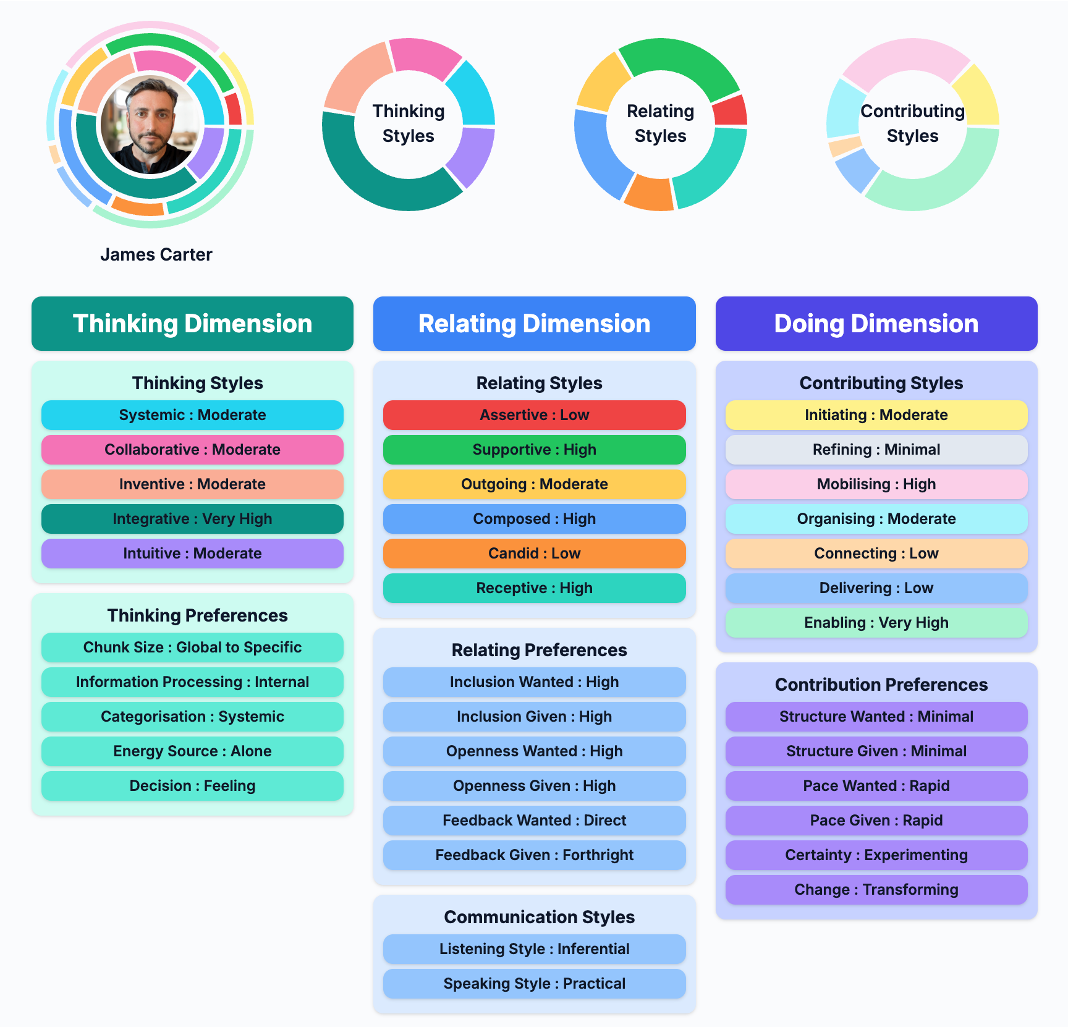
A sample Co-Valence profile. Each person's map is unique — and most useful when seen alongside their team's.
What changes when a team uses it well
For you
You finally have language for what you already knew
Most people recognise themselves in their profile immediately. What changes is having the words for it, and being able to share that with the people you work with, on your terms.
For the team
Friction gets a name — and a way forward
Most team friction isn't about attitude or intent. It's about people operating from different defaults and not knowing it. When you can see the differences, you stop taking them personally and start working with them.
For the project
Better decisions, fewer costly misreads
Teams that understand how they collectively think and communicate make fewer assumptions, catch more blind spots, and waste less time on misalignment that should have been a five-minute conversation.
Co-Valence doesn't tell you who someone is. It gives you a shared map so you can navigate together more honestly, and with a lot less guesswork.
What you're being asked to do
The time commitment is small. What you do with it is up to you.
Complete the questionnaire
A straightforward set of questions about how you work. No right or wrong answers, just honest ones. You can do it in a single sitting.
10 to 15 minutesReceive your profile
Your results are your own first. Some of what you see is shared with the team; some stays private to you. You're in control of what you disclose.
Straight awayWork through it together
A facilitated session where the team's profiles are brought together — not to judge or compare, but to understand what makes this particular group of people tick.
Time to reflectQuestions you might have
Is this a test? Can I pass or fail?
No. Co-Valence measures preferences, not performance or potential. There are no better or worse results, every profile position is valid. The purpose is self-awareness and team understanding, not evaluation.
Will my results be shared with leadership?
The session focuses on team dynamics, not individual assessment. Some aspects of your profile are shared with your team to enable genuine conversation; others are visible only to you. Nothing is used for performance decisions.
We've done things like this before and nothing changed. Why is this different?
Most psychometric tools produce insight that lives in a workshop and then disappears. Co-Valence is designed to stay in the room: in the language your team uses, in how you run meetings, how you give feedback, how you make decisions. The profile stays live and adds value after the session.
What if I don't agree with my profile?
That's a useful conversation in itself. Sometimes a gap between the profile and how you see yourself tells you something interesting — about the context you're operating in, or the identity you've built over time. And if, once you've learned more about what the aspects actually mean, you want to revisit your answers, you can retake it at any time. The profile is a starting point, not a verdict.
Your engagement is what makes this work
Co-Valence is only as useful as the honesty people bring to it. Fifteen minutes of your time, approached with genuine curiosity, is what turns a questionnaire into something you and your team can actually use.
Find out more
For more context on Co-Valence and how it supports teams, you can visit the main website.
Visit co-valence.com