Co-Valence
Great teams,
happy people;
at scale
Co-Valence helps your teams build trust, have better conversations about how they work together, and keep growing; with a guiding app that scales team coaching across your organisation.
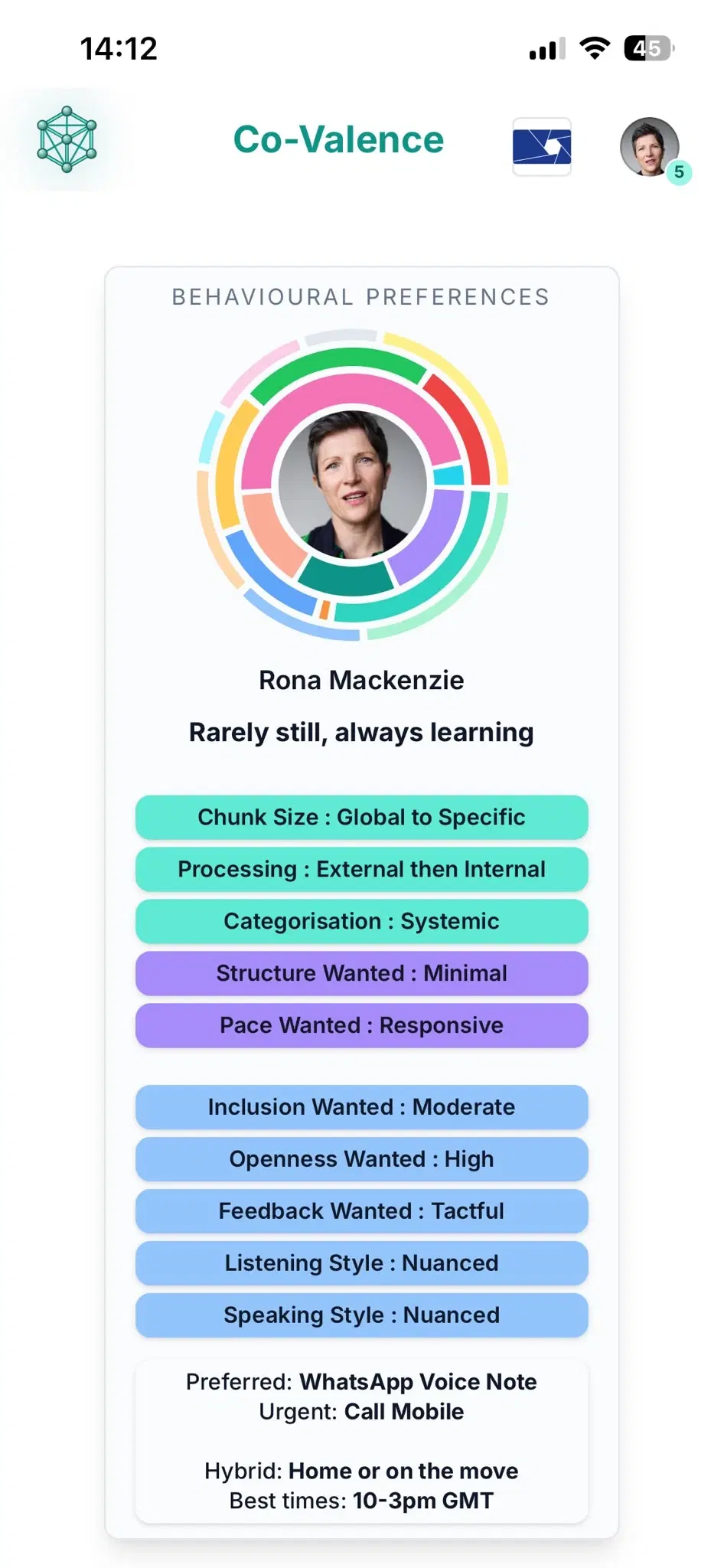

A coach for every team you are part of
A team performance coach to drive understanding, cohesion and performance; built on a practical preferences model that draws on the most useful elements of major frameworks and moves beyond personality types, with guided flows for the meta conversations that help teams agree how they work together.
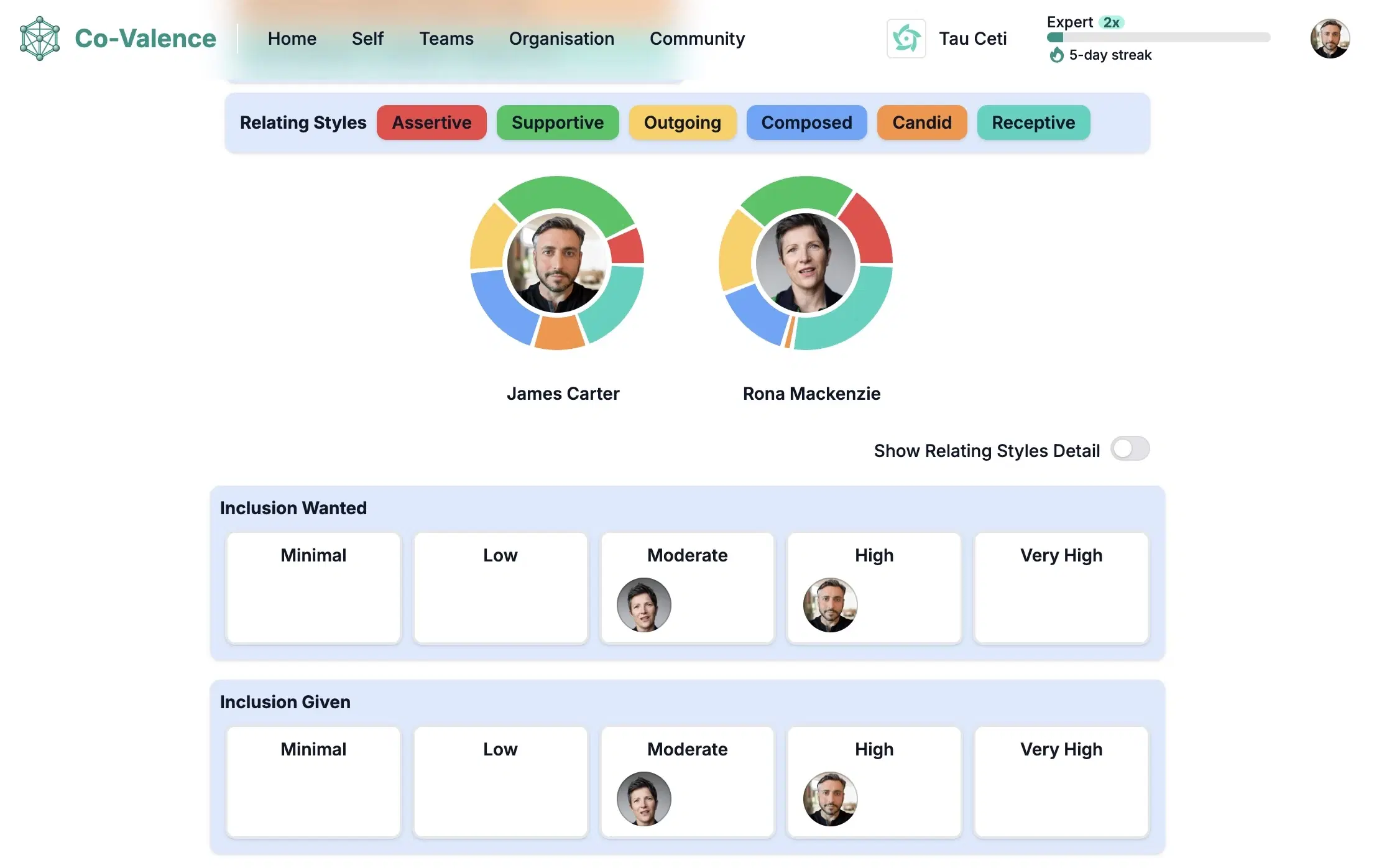
Develop shared understanding, trust and flexibility
Build deep understanding with a practical model of 37 preferences across how we think, relate and work; a shared language for recognising and valuing difference.
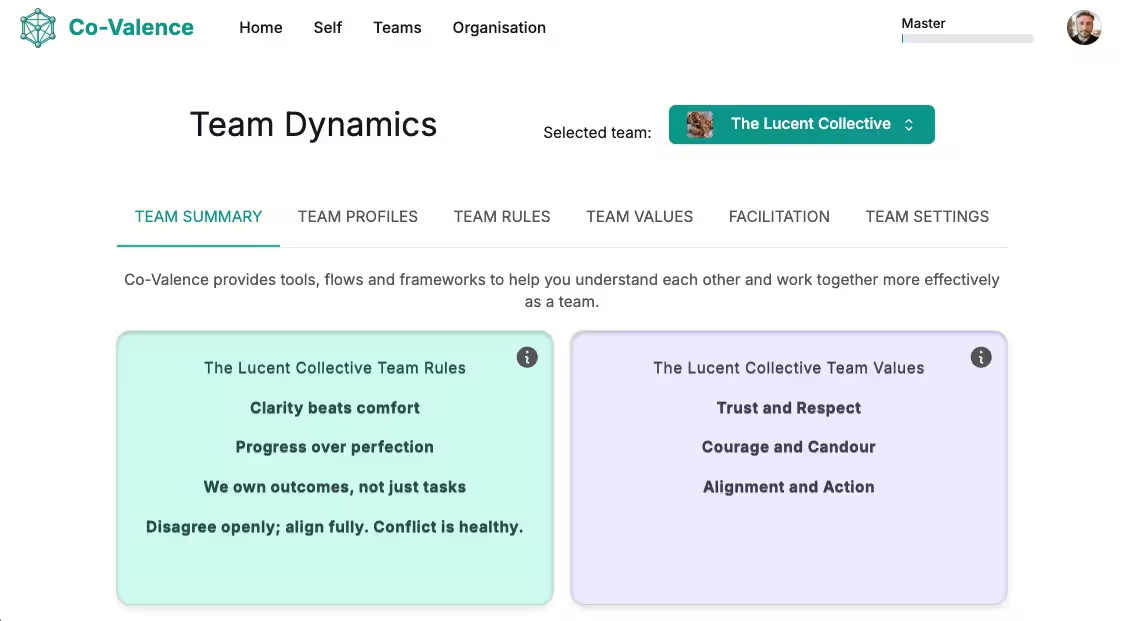
Create team rules and values to drive success
Teams create self-defined and unanimously agreed shared rules and values to help them become more cohesive and effective.
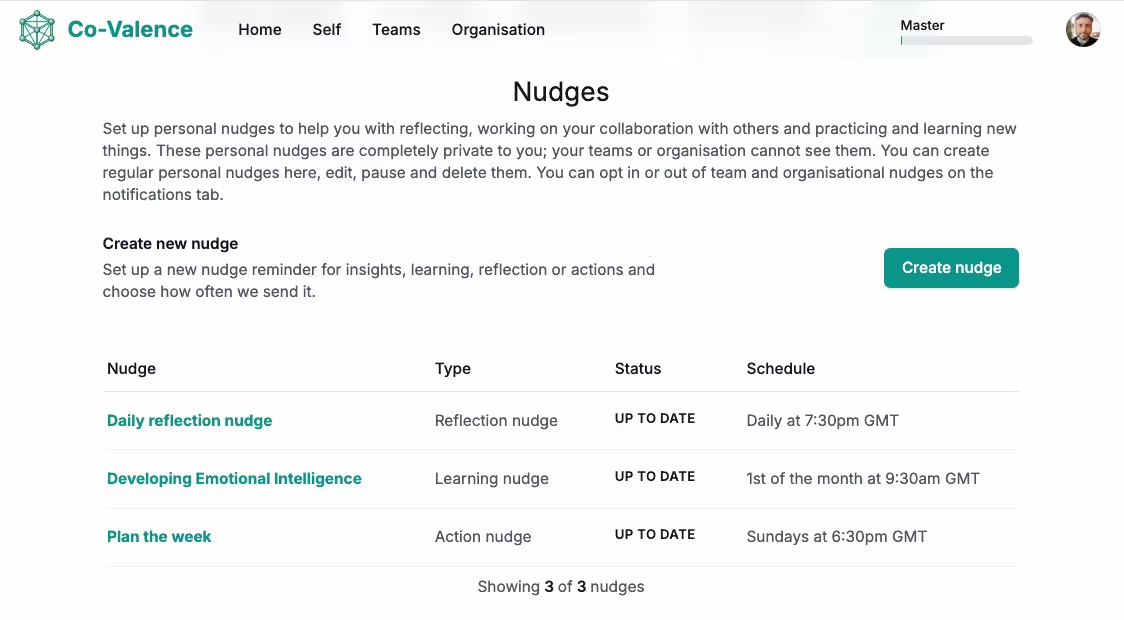
Nurture behavioural change over time
Personal and team nudges help learnings, reflections and insight stick, nurturing and developing successful long term behavioural change.
Preferences, not personality types
Co-Valence describes 37 preferences across how you think, relate and work; what you tend to reach for when you have a free choice. Preferences are shaped by context and experience, they can change, and every position brings something useful, so difference becomes something your team can recognise, celebrate and talk about openly.
Thinking10 preferences
How you prefer to take in information, make sense of things and decide.
Five thinking styles, from Systemic to Intuitive, plus how you like information chunked, processed and categorised, where your energy comes from and how you make decisions.
Relating14 preferences
How you prefer to show up with, connect to and communicate with others.
Six relating styles, from Assertive to Receptive, the inclusion, openness and feedback you want from others and tend to give in return, and how you speak and listen.
Doing13 preferences
How you prefer to contribute to shared work, and in what conditions.
Seven working styles, from Initiating to Enabling, the structure and pace you want and give, and how you approach certainty and change.
What the model stands for
- Preferences, not identity
- Your profile shows what you tend to reach for today; never a type, a label or a verdict. Preferences move with role, context and practice, and you can revisit your answers at any time.
- No right or wrong
- Every position brings something useful, and has a cost when it is overused or unmet. A team needs the spread.
- Difference is information
- Most friction between well-meaning people is a preference gap rather than a character flaw. Naming the gap turns blame into a shared problem to solve.
- Your data, your voice
- You speak for your own preferences and choose how much others see. Nobody uses a profile to explain someone else.
A language for healthy meta conversations
A meta conversation is a conversation about how you work together: how you talk, decide, disagree and support each other. A shared, neutral language makes them easier to start; “we have different pace preferences” is far easier to say than “you rush”.
- 1
Notice. Spot the moment, and the story you are telling about it.
- 2
Name. Say what is happening from both sides; speak for yourself and listen to understand.
- 3
Normalise. Recognise what each position brings and what it costs.
- 4
Navigate. Find a way through together; flex, try a new habit or a different approach.
- 5
Note and revisit. Record what you agreed, and check back later.
Integrated and continuous improvement, coaching and development
Great teams are not built overnight; they are built over time. Instead of a one off personality test and offsite, build team development and a shared language for preferences into daily work.
Understand the people you work with
Develop a deeper understanding of yourself and the people you work with. This understanding helps everyone you work with to embrace differences and operate more flexibly and effectively together.
Develop team flexibility and performance
Integrating a 5 to 10 minute flow in each team meeting develops a habit of creating meaningful meta conversations that continually sharpen the saw and help the team improve how they work together.
Communicate and connect more effectively
Everyone has different communication preferences. Share how you prefer to be contacted with everyone in the organisation, so they can approach you and connect with you at the best time, and using the best channel.
Rules and Values
A lot of misunderstandings occur because people are operating by different and unspoken rules and values. Defining self-proposed and unanimously agreed rules cuts out confusion and enables effective working to flourish.
Create a common language for preferences
Co-Valence gives a simple and effective language for behavioural preferences and differences, allowing people to discuss, compare and adapt with flexibility to work together more effectively.
Continually improve yourself and your teams
Configure meaningful nudges to help you and your teams reflect, learn and act on developing improvements to working behaviours, processes and activities.
Get Co-Valence
in your organisation
Meaningful cohesion happens with sustained action, embedded over time, with real intent.
Let’s make this happen for you.
Co-Valence makes individuals, teams and organisations better
Sustainable and effective personal, team, organisational and cultural development embedded day to day.
Useful for you, each other, your team and your organisation
Organisations bring Co-Valence in for their teams, and people keep coming back because it is useful to them personally. Everything here is in the app today.
For you
Understand your own preferences and keep developing.
- Your 37 preferences, with written insight and guided walkthroughs
- Home, with one clear next move and the reason for it
- Personal nudges and learning topics on your own schedule
- Your journey and private reflection notes, never visible to your organisation
With one person
Work better with the people you work most closely with.
- Wanted and given; what you each want from the other, and what you tend to give
- Six one-to-one flows for communicating, deciding, feedback and conflict
- How to reach me, and a one-page communication summary
For your team
Agree how you work together, and keep improving it.
- Team profiles showing styles, coverage and gaps
- Live team flows and profile discussions, run together in meetings
- Rules and values everyone agrees, reviewed over time
- Project kickstarts and retrospectives
- Stakeholder, client and recruitment fit conversations
For your organisation
See how people are doing, and act on it together.
- Core Pulse; 11 items, 5 themes and one index, anonymous to everyone
- Results, trends and published actions for everyone who takes part
- An organisation view and people directory
Co-Valence keeps growing with the teams that use it. We release improvements regularly, and our VIP users vote on what we build next.
Clear Pricing, Crazy Value
Unlock team and organisational performance mastery with the cost of a couple of coffees a month per person.
Core
£9 per user per month
Everything a team needs to understand its preferences and agree how it works together, with supported implementation.
- 37 Behavioural Preferences, with Written Insight
- Wanted and Given; One-to-One Comparisons
- Team Profiles and Live Team Flows
- Team Rules and Values
- Kick Starts and Retrospectives
- Stakeholder, Client and Recruitment Fit Conversations
- Personal and Team Nudges
- Learning Topics and Your Journey
- Core Pulse, Results and Actions
- Human Support
Complete
£12 per user per month
Everything in Core, plus deeper profile packs switched on for your organisation as each one is released.
- Everything in Core, Plus...
- Behavioural Range (in testing)
- Capabilities and Leadership (in development)
- Extended Preferences (in development)
Enterprise
Tailored for you
Fully integrated and tailored for the needs of your organisation.
- Everything in Complete, Plus...
- Unlimited users
- Strategic Culture Change
- Integrated Leadership Development
- Bespoke CPD webinars
- Enhanced Improvement Support
Frequently asked questions
If you have anything else you want to ask, reach out to us.
Is this just another personality test?
No; it supersedes them. Co-Valence talks preferences rather than personality types, because preferences are shaped by context, can change and have no right or wrong answer. That makes difference easier to recognise and celebrate, and gives teams a neutral language for healthy meta conversations. It is ongoing team support that shapes day-to-day behaviour, not a one-off insight report.
How long does it take to see value?
Most teams see immediate value within the first meeting, and start to see deeper behaviour change over the first 30–90 days as nudges and team flows embed.
Do we need a facilitator or coach to use it?
No. Teams can self-run flows easily. Coaches and consultants can add value and can work well in conjunction with Co-Valence for senior teams, but the platform stands on its own.
How much effort is this for our team?
Very low. Setup takes minutes, not days. Most interactions are lightweight nudges and short reflections, not long exercises.
What problem does Co-Valence solve?
It reduces friction, misunderstanding, and drift in teams by making preferences, expectations, and team rules explicit, practical and effective.
Will this work for remote or hybrid teams?
Even more so. Co-Valence makes invisible assumptions visible and resolves unspoken issues, which is where remote teams struggle most.
Does this replace HR or L&D initiatives?
No. It complements them by providing practical, everyday cultural infrastructure rather than another programme. It helps create a common language for behaviour that enriches and supports cultural development.
Is our data safe and private?
Yes. People own their data and choose how much of their preferences others see. Pulse is anonymous; nobody, owners included, can see who answered. Personal reflections and your journey are never visible to your organisation, and personal data is handled under UK GDPR. Co-Valence is designed for trust, not surveillance.
Who is Co-Valence best for?
Teams that want to work better together without heavy training, jargon, or endless workshops. Particularly useful for hybrid or fast-moving teams.
What makes Co-Valence different from workshops or coaching?
Workshops are episodic. Co-Valence is persistent. It lives inside the working week, reinforcing habits long after the session ends. It creates long lasting value that compounds and scales across your organisation.
How does pricing work?
Simple annual per-user pricing, with pilots and scale discounts available. No hidden costs or long contracts.
Why should we try Co-Valence now?
Because small, consistent improvements in how people work together compound fast. Co-Valence makes that easy to start.
Get Co-Valence
in your organisation
Meaningful cohesion happens with sustained action, embedded over time, with real intent.
Let’s make this happen for you.